 نسخه فارسی
When Weeks of War Consume Years of Munitions Production
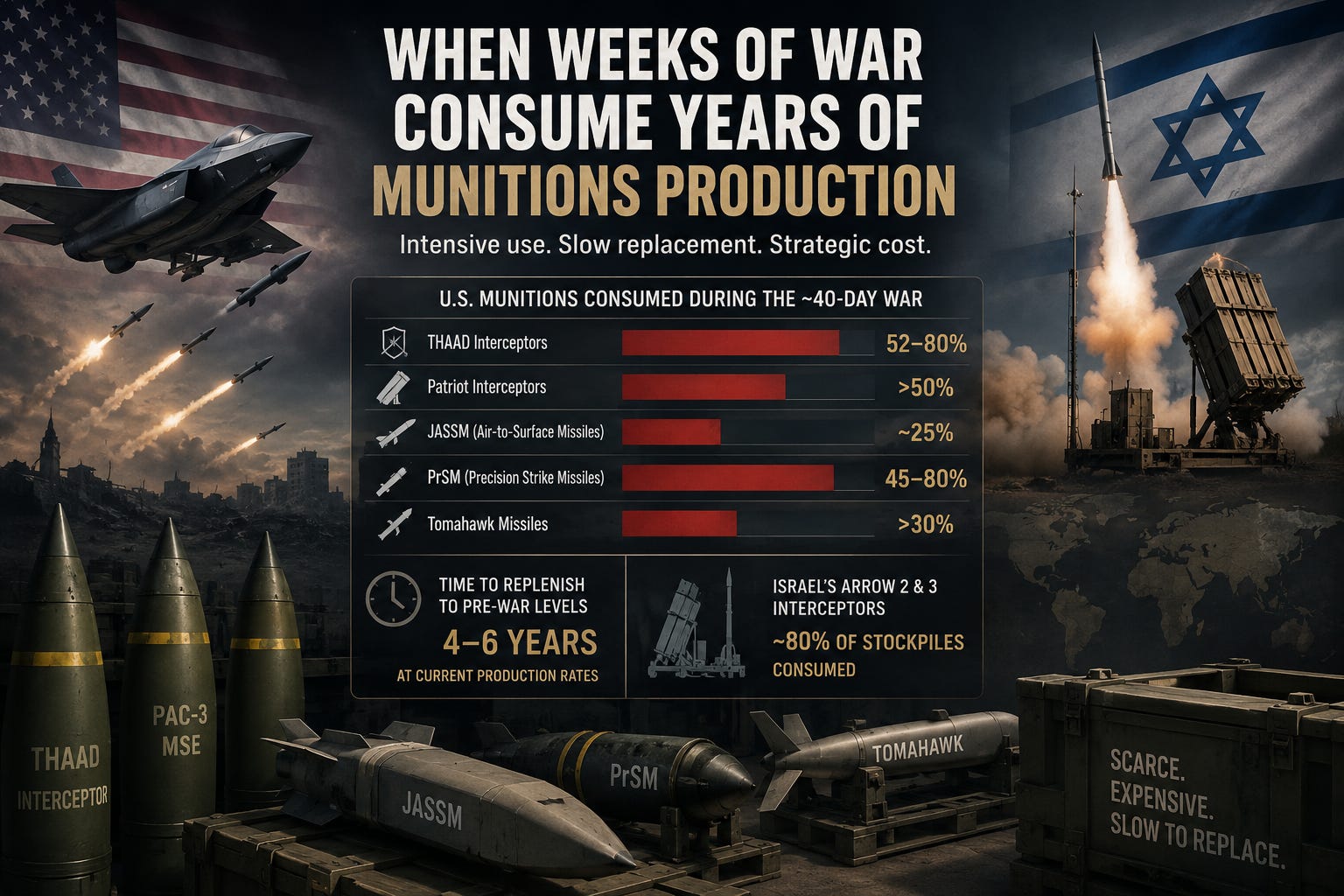
One of the important realities of the recent war is that the United States and Israel did not only strike Iran. To sustain the war effort, they also consumed a significant portion of their own critical, costly, and difficult-to-replace stockpiles.
This depletion is especially significant in two areas: missile defense and scarce munitions.
The signs of this problem were already visible earlier. Now, however, as time has passed, more precise estimates of munitions expenditure are available. Estimates published by the Center for Strategic and International Studies (CSIS) show that, during the roughly 40-day air and missile campaign, the United States made extensive use of several types of key munitions. In some cases, replenishing stockpiles to pre-war levels at the current production rate would take several years.
According to these estimates, during the war the United States used approximately 52 to 80 percent of its THAAD interceptor inventory, more than half of its Patriot interceptors, around 25 percent of its JASSM air-to-surface missiles, around 45 to 80 percent of its PrSM surface-to-surface missile stockpiles—that is, Precision Strike Missiles—and more than 30 percent of its Tomahawk stockpiles.
The more important point is that, at current production rates, replenishing these stockpiles to pre-war levels would take roughly four to six years. In other words, the issue is not only the number of missiles fired; it is that replacing them is neither quick nor simple.
On the Israeli side, too, pressure on missile-defense systems has been very serious, especially on the Arrow 2 and Arrow 3 interceptors used to counter Iranian ballistic missiles. Some assessments indicate that Israel consumed around 80 percent of its stockpiles of these interceptors over the course of the war.
Of course, this depletion does not mean that the United States has lost its ability to attack. This distinction is very important. The United States still has more options when it comes to offensive weapons and possesses a diverse range of munitions that allow it to rely on alternative options. The main pressure point lies more in the area of missile defense, costly interceptors, and munitions that take time to produce and replace.
For this reason, the United States has informed some of its military partners in Europe and East Asia that delivery of the THAAD missile-defense systems they had ordered will be delayed. This means that munitions expenditure in the war was not only an issue related to the Iran theater; its effects have also extended to U.S. military commitments in other regions.
This is where the war moves beyond the level of a military operation. When munitions consumed in a few weeks are equivalent to several years of normal production, the issue is no longer simply the number of attacks or destroyed targets. It is industrial capacity, the time required to replenish stockpiles, and the ability to sustain an attritional war.
This is also the perspective from which the Wall Street Journal report on the Pentagon’s new plan to procure 10,000 low-cost cruise missiles over the next three years should be viewed. These missiles are intended to complement expensive systems such as Tomahawk. This decision is not merely routine military procurement; it is a sign that Washington wants to reduce its dependence on expensive, scarce, and slow-to-replace munitions while increasing its ability to sustain an attritional war.
The more important question now is this:
Exactly how much of Iran’s military capability did this scale of munitions expenditure and pressure on U.S. and Israeli stockpiles degrade?
Thanks for reading! Subscribe for free to receive new posts and support my work.