 نسخه فارسی
Why Iran Signed an MoU It Knows May Not Last
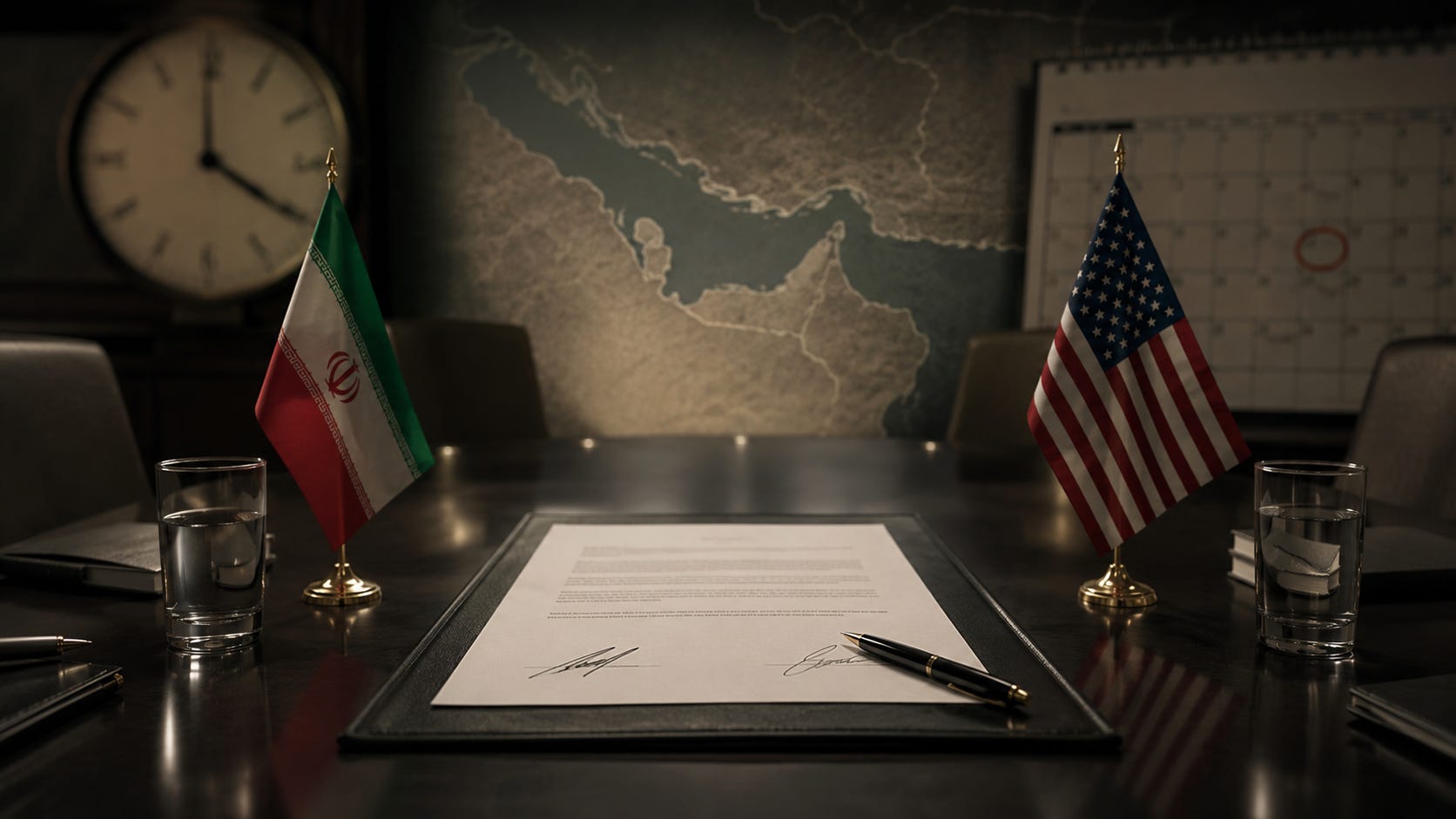
How can a memorandum of understanding that everyone knows is temporary still be a rational choice?
This paradox lies at the heart of the dilemma facing Iranian decision-makers. The MoU that has now been signed brings neither peace nor an end to the war. Its formal validity has been announced as 60 days, but the variable that will determine its actual lifespan lies elsewhere: the U.S. midterm election calendar in November.
The question in this note, however, is not whether the agreement is right or wrong. The issue is not whether this MoU is ideal—it clearly is not. The issue is the cost-benefit calculation of the alternative: the continuation of maximum pressure.
The agreement, therefore, should be understood as a cost-benefit calculation among competing paths.
Two Paths, One Choice
Tehran is, in practice, standing between two competing paths.
The first is to continue maximum pressure and preserve the leverage of closing the Strait of Hormuz. Its logic is simple: now is not the time to give up leverage, and greater costs must be imposed on the United States.
The second is to consolidate current gains and make use of the limited political window that has opened in Washington and will probably close after the elections.
The argument of this article is that, in a sober cost-benefit calculation, the second path is more logical. To assess this, three logics must be considered together: the logic of time, the logic of the battlefield, and the logic of economics.
The Logic of Time: A Commodity with an Expiration Date
U.S. political flexibility toward Iran is a perishable commodity. It has a shelf life, and that date is the midterm elections.
Why now? The answer should be sought not in diplomacy, but at the gas pump. Before the elections, Trump needs, above all, to keep energy prices under control. Gas prices are an immediate electoral reality, something American voters feel every day in their own pockets.
For this reason, Trump currently has a strong incentive to move toward calm and de-escalation in order to keep energy prices low. It is precisely this incentive that has opened a window of opportunity for Iran to extract concessions from Washington.
Why will this window close? Because after the elections, the political landscape will change. Once the November elections are behind him, Trump will have almost a full year before the next presidential campaign begins. During that year, he will face virtually no pressure to make concessions to Iran. On the contrary, all the pressure will push in the direction of refusing concessions.
And if, during this period, Democrats gain control of Congress—which is highly possible—they will use tools such as budgetary leverage, subpoena power, and even the threat of impeachment to restrict the administration’s room for any new opening with Iran and to hold Trump accountable for every concession.
In other words, the current period before November is the most important moment in which the U.S. administration simultaneously possesses the political capital, legislative breathing room, and necessary incentive for a serious agreement and for making concessions to Iran.
This logic is not tied personally to Trump. Any U.S. administration on the eve of an election would, more or less, behave in the same way.
The Logic of the Battlefield: Not Separation, but Distance
The most important operational gain of this temporary MoU is not peace; it is keeping the United States out of Israel’s defensive equation.
Here, one must be precise. The claim is not that there will be a “complete separation” between Washington and Tel Aviv—such a thing is, at least for now, impossible. Rather, the point is the “widening of the distance” between them, something recent behavioral evidence supports.
The evidence is considerable:
▪️ Tense exchanges between Trump and Netanyahu, which Trump confirmed.
▪️ Trump’s public warning on Israel’s Channel 12 that if Netanyahu enters the war again, he will have to fight alone.
▪️ The absence of U.S. air defenses in intercepting Iran’s recent missiles in response to the bombing of Beirut.
▪️ Washington’s reluctance to use up more THAAD interceptors, given that between 60 and 80 percent of the total inventory of this system has already been used.
At the domestic level, opposition from some members of Trump’s own party to the continuation of the conflict reinforces this picture, alongside polls showing that the Republican voter base also wants it to end. Trump therefore now has a strong incentive to leave Israel to face Iran alone—something he has also shown in practice.
But why does the absence of the United States matter so much? Because a large part of Israel’s air defense has, in practice, rested on the United States. In the 40-day war, the United States fired more interceptor missiles than Israel itself to protect Israeli airspace.
When this pillar is removed from Israel’s defensive structure, the result is clear: a higher missile penetration rate, rising defensive costs for Tel Aviv, and the full transfer of the air-defense burden to an already depleted stockpile. Reports point to the use of around 80 percent of Arrow interceptors and more than half of David’s Sling interceptors in the 12-day and 40-day wars, as well as the lengthy timeline required to replace them.
In such a situation, if Israel violates the ceasefire and Iran responds with missiles while the United States stays out, the balance shifts noticeably in Iran’s favor, and Iran’s ability to deliver heavy strikes increases.
The Logic of Economics: Which Path Is More Costly?
Instead of asking, “Is the agreement good?”, one should ask, “Which path is more costly?”
The path of continued pressure carries cumulative costs that are often not taken seriously enough: the continuation of the maritime blockade against Iran itself, the intensification of economic pressure, and—most importantly—the rising risk of social tensions arising from that same pressure, a risk that, as the events of January 8–9 showed, can be highly costly.
This pressure also extends beyond Iran’s borders: the continued closure of the strait harms Iran’s main ally, China, as well. Beijing’s export-oriented economy is tied to the health of the global economy, and a downturn caused by the closure of Hormuz would hit China’s customers and, consequently, China itself.
By contrast, what is the cost of the path of consolidation? Lower oil prices and the loss of leverage. But this leverage never truly placed pressure on Israel—the main driver of the tensions. Rather, it weighed on the United States and its Arab allies. That was its purpose from the beginning: to push the United States and its regional partners to step back from the conflict, a goal that, at least for now, has been achieved.
Here, there is a key point: through consolidation, Iran is not merely buying economic breathing space; it is buying time—for rebuilding stockpiles, reorganizing its defenses, and repairing the economy—at a moment when the adversary’s stockpiles are more depleted than ever and replacing interceptors will take more than four years.
This is where the benefits become asymmetric. If the MoU lasts for several months, the United States gains only calm in the oil market. Iran, however, also breaks the blockade, buys time, and still retains control over the strait. It is true that during this pause the other side will also rebuild. But when replacing its stockpiles takes years, the rate of replenishment favors the side that has been freed from blockade.
Conclusion: The Clock Set in Washington
This MoU is neither peace nor the end of the matter. It is a calendar-bound pause whose hands are set not by its text, but by the U.S. electoral calendar. The MoU is meant to keep the United States away from the field of conflict for now, break the pressure of the blockade, and extract concessions from Washington’s electoral bind. Its value lies in temporarily shifting the strategic environment in Iran’s favor, which could also lead to more durable changes.
In the meantime, Iran faces an unusual trade-off: giving up tangible and costly leverage in exchange for something that cannot be seen, cannot be held, and is sometimes assumed to exist indefinitely—opportunity.
And this is precisely where every strategic calculation becomes difficult: leverage is visible, countable, and measurable. Time, however, reveals its value only once it has been lost.
Thanks for reading! Subscribe for free to receive new posts and support my work.