 نسخه فارسی

The Mecca Pact: Balancing Against Israel, Not Iran
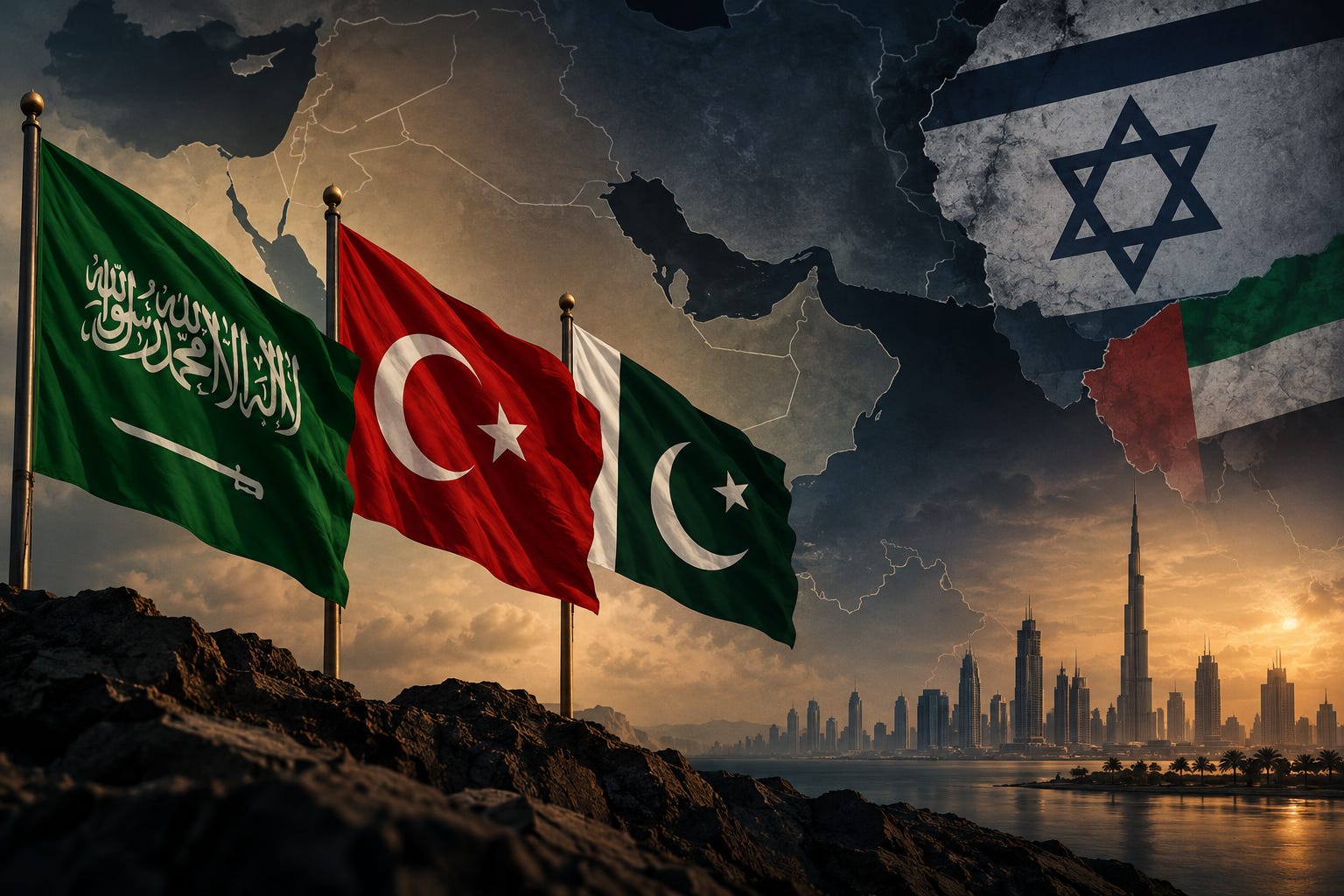
At first glance, the defense pact between Saudi Arabia, Turkey, and Pakistan may appear to be a response to Iran. But if the pact was formed to contain Iran, one simple question remains unanswered: why would Turkey and Pakistan join such an arrangement?
Saudi Arabia undoubtedly perceives Iran, Yemen’s Houthis, and other Tehran-aligned forces as threats. But this is not a threat shared by all three members of the pact. What draws their security calculations closer together is not so much Iran as Israel and the emerging regional order taking shape around it, particularly with the involvement of the United Arab Emirates.
1. Riyadh in Search of a Second Security Umbrella
The first message of the Mecca Pact is that Riyadh no longer wants to tie its security exclusively to a U.S. guarantee. This does not mean breaking with Washington; it means ending exclusive reliance on it.
Israel’s attack on Qatar was an important turning point. When a country close to Washington and host to one of the most important U.S. military bases can itself become a target of Israel, the credibility of the U.S. security guarantee inevitably comes into question. The forty-day war deepened these doubts considerably among the Gulf states. The Mecca Pact should therefore be understood as part of Saudi Arabia’s effort to build an additional layer of security that does not depend entirely on the United States.
2. If Iran Were the Target, Why Turkey and Pakistan?
Collective defense pacts are generally formed around a common threat. Iran does not constitute such a threat for all three countries.
Saudi Arabia views Iran and Tehran-aligned forces as threats, but neither Pakistan nor Turkey has any incentive to go to war with Iran.
Despite its bilateral defense pact with Saudi Arabia, Pakistan not only refrained from entering the war against Iran but also helped Tehran circumvent the U.S. naval blockade, prevented terrorist groups from entering Iran, and mediated in an effort to halt the war.
Turkey likewise prevented armed Kurdish groups from becoming active against Iran during the war and engaged in political consultations to contain the conflict and reach an agreement.
Iran, therefore, is not a common threat capable of uniting these three countries. Their interests regarding Iran differ; with respect to Israel, however, their security calculations are more closely aligned.
3. Israel: The Threat Bringing All Three Closer Together
Once Israel is placed at the center of the analysis, the composition of the pact becomes easier to understand.
For Turkey, the issue is no longer simply Palestine. Erdoğan has explicitly stated that Israeli actions in Syria and Lebanon threaten Turkey’s security. Pakistan’s position is even more explicit. Just one day after the Mecca Pact was signed, Pakistan’s defense minister described Israel as a threat to the entire Islamic world and called for the formation of a joint military front against it.
Israel, for its part, has also taken explicit positions against both countries in recent months. This confrontation is directly connected to Israel’s security doctrine after October 7: Tel Aviv is increasingly seeking to contain or eliminate potential threats before they materialize. Within this logic, a Turkey capable of restricting Israel’s freedom of action in Syria, the Eastern Mediterranean, and elsewhere becomes a security concern in its own right.
Israel has therefore, to varying degrees, become a security concern for all three members of the pact.
4. The UAE: The Arab Pillar of the Balance
The rivalry between Riyadh and Abu Dhabi has long moved beyond disagreements over oil and trade and developed into a broader security and regional rivalry. From Yemen to Sudan, Somalia, and other parts of the Horn of Africa, Saudi Arabia and the UAE are effectively engaged in a proxy war. Even before the forty-day war, Saudi Arabia had already moved closer to Egypt and Turkey in an effort to balance against the UAE.
On the other side, the UAE is Israel’s closest Arab partner and one of the principal parties to the Abraham Accords. In the Red Sea, the Horn of Africa, and the region’s emerging security architecture, the interests of Abu Dhabi and Tel Aviv have become intertwined across several arenas.
From this perspective, the Mecca Pact can be understood as part of the emergence of a regional counterweight to the Israel–UAE axis.
For this reason, describing the Mecca Pact as a “Sunni NATO” against Iran is misleading. Iran is not the common threat that can explain the defense alignment among Saudi Arabia, Turkey, and Pakistan. The common factor is Israel.
The Mecca Pact should instead be understood as a response by three major regional powers to a broader shift: since October 7, Israel has expanded the scope of its military intervention and is seeking to make its freedom of action part of the emerging regional order.
The Mecca Pact is an attempt to prevent precisely this outcome: to build a counterweight to Israel and its allies before Tel Aviv’s military superiority effectively becomes a right to intervene across the region at little cost.