 نسخه فارسی
The Divide in Washington: The Hidden Cost of War for Israel
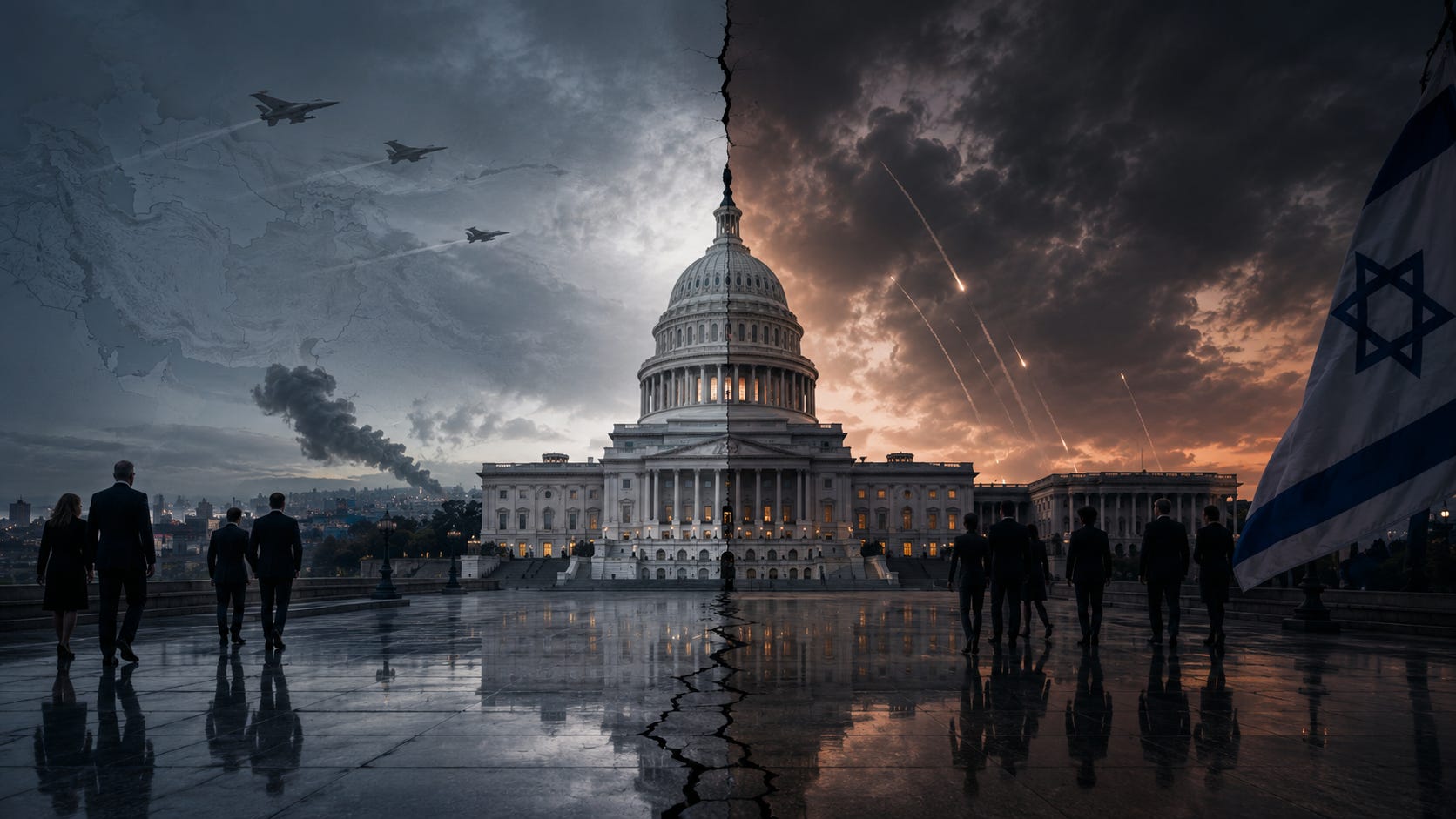
If we view the war only through the lens of military strikes and infrastructure damage, one might conclude that Israel has the upper hand. In the past day alone, Israel has targeted 13 industrial sites and infrastructure facilities, including steel and cement factories and power plants. But this is only part of the picture. Behind this air and battlefield superiority, a divide is emerging in Washington that could, in the long term, prove far more costly for Israel than military losses. A war that may be moving in Israel’s favor in the air has begun to show signs of erosion at the political and strategic levels. For this reason, any accurate assessment of Israel’s position must examine the battlefield and political developments together.
From Israel’s perspective on the battlefield, it is important to note that the closure of the Strait of Hormuz or damage to the infrastructure of the Gulf states would harm the United States and the global economy more than it would directly harm Israel. Israel may even welcome the weakening of some Arab countries. As a result, a significant part of the infrastructure and economic damage affecting Israel is essentially limited to the missiles that strike Israeli territory.
By contrast, Israel’s strategic objective in the war is not merely to repel an immediate threat. It is the long-term weakening of Iran: an Iran that, from Israel’s perspective, should not possess effective defensive, infrastructural, economic, or scientific capabilities. Therefore, the more damage Israel can inflict on Iran’s infrastructure with U.S. assistance, the closer it moves to its objective. Viewed from this angle, despite the damage Iran has inflicted on Israel, it appears that Israel is currently causing more damage to Iran’s infrastructure than it is suffering in military and infrastructural losses. This is why Israel is strongly committed to continuing the war.
But the main issue is not only the battlefield. The more important issue is the political and strategic cost of this war for Israel. The clearest manifestation of this cost is the erosion of political support for Israel in the United States and other countries.
Public-opinion data point to an important shift: sympathy and political support for Israel are no longer as self-evident or unified as they once were, and a significant part of the American public increasingly sees Israel as responsible for the costs of this war. This shift in perception, together with growing debate in American media and elite discourse, shows that the divide over Israel has moved from the margins to the center of U.S. domestic politics. This divide is visible not only among Democrats, but also within the Republican Party and Trump’s support base. For this reason, the longer the war continues and the more its economic effects become visible in the lives of people in the United States and around the world, the more public opinion will turn away from Israel.
This divide is not limited to public opinion or media discourse. Its signs can also be seen within the U.S. political and security establishment. The resignation of Joe Kent, the director of the U.S. counterterrorism center, amid the war is significant from this perspective. He described the main reason for his resignation as the United States’ entry into a costly war that, according to him, began solely under Israeli pressure and on the basis of faulty intelligence from Mossad. The importance of this stance lies not only in Joe Kent himself, but also in the fact that he has explicitly stated that many of his colleagues in the security and military agencies broadly share the same view. This shows that the divide over Israel has reached senior decision-making levels and U.S. security institutions. From this perspective, Israel may, in the long term, be losing its most important strategic backing: the political consensus and supportive public opinion it has enjoyed in the West.
If the United States ultimately moves toward halting the war and providing guarantees to prevent a renewed attack, this could amount to a serious strategic loss for Israel. The reality is that without direct and comprehensive U.S. support, Israel does not have the capacity to sustain a broad and prolonged confrontation with Iran. If it had the capacity to do so on its own, there would have been no need for decades of lobbying to draw the United States into a direct war with Iran.
The conclusion is clear: in the short term, Israel may be inflicting heavy infrastructure and economic damage on Iran. But in the long term, at the political and strategic levels, Israel itself is facing losses that will be extremely difficult to repair. Air and battlefield superiority do not necessarily mean strategic victory. Perhaps the most important cost this war imposes on Israel is not in the skies of the region, but in the divide now emerging in Washington.
Thanks for reading! This post is public so feel free to share it.