 نسخه فارسی
Israel’s Post-October 7 Security Doctrine
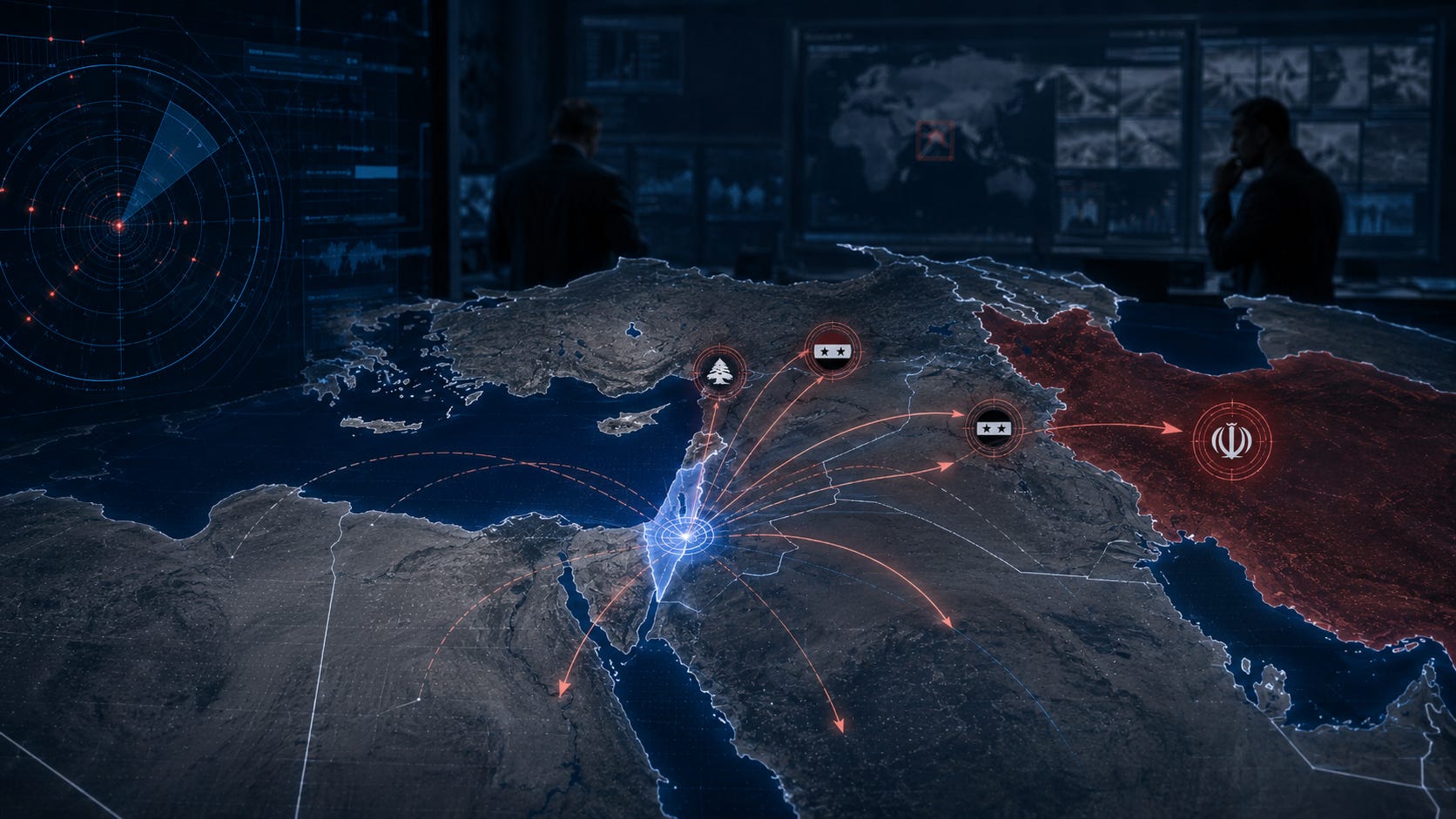
Israel took a different path from Iran after October 7.
For Israel, October 7 was not merely a security attack; it was a doctrinal shock. Just as September 11 pushed U.S. security doctrine toward preventive war, October 7 reinforced within Israel the view that potential threats should not be tolerated until they materialize.
Shamsoddin ShariatiIran’s Security Doctrine After October 7After October 7, Iran sought to preserve regional deterrence while keeping the crisis at a manageable level and avoiding escalation with the United States and Israel. By contrast, after the shock of October 7, Israel reached the conclusion that even potential threats had to be treated as imminent threats and targeted before they materialized…Read more4 days ago · Shamsoddin ShariatiFrom that point onward, Israel’s security logic shifted from “threat containment” toward the “preemptive elimination of potential threats.” The conservative newspaper The Times of Israel highlighted the same point in an analysis following the assassination of Hassan Nasrallah in 2024: Iran was trying, through restraint, to preserve part of the old regional order, while Israel, after October 7, had adopted a more offensive posture.
In the same analysis, John Hannah of the Jewish Institute for National Security of America (JINSA) said that the doctrines of preemption and prevention had returned more forcefully to Israel’s national security doctrine and would not disappear anytime soon.
This is the key point. In Israel’s new logic, a potential threat is no longer a remote possibility; it is a danger that must be eliminated before it fully develops. In this view, the distance between “it may one day become dangerous” and “it must be targeted now” becomes very short, even if the intelligence assessments of Israel’s main ally do not confirm the immediacy of such a threat.
This divide was also visible within the U.S. security apparatus. In February–March 2025, Tulsi Gabbard, then U.S. Director of National Intelligence, said in formal testimony before Congress that the U.S. intelligence community continued to assess that Iran was not building a nuclear weapon and that its suspended nuclear weapons program had not been reactivated.
Later, Joe Kent, the former director of the U.S. National Counterterrorism Center, also emphasized that Iran was not an imminent threat to the United States. In his interviews, he stated that the portrayal Israel conveyed to Washington regarding the urgency of the Iranian threat did not align with the official assessments of the U.S. intelligence community. This was the point at which the logic of potential threat replaced a sober assessment of actual threat.
From this perspective, the beginning of the 12-day war in May–June 2025 should not be seen as an isolated event detached from what came before. These attacks took place in an environment in which Israel’s narrative of the urgency of the Iranian threat had prevailed over the assessment of the U.S. intelligence community. The war of May–June 2025 was the eruption point of a divide that had taken shape after October 7: the divide between crisis management by Iran and the preemptive elimination of threats by Israel.
This logic was not limited to Iran. From this perspective, one can also understand Israel’s growing concern about Turkey, as well as its extensive attacks on Syria’s military infrastructure. The issue is not only the existence of an actual threat. Any actor capable of limiting Israel’s freedom of action in the future falls within the category of threat.
Even toward Syria, which, after the change in power, has distanced itself from the Iran-aligned axis and is seeking to redefine its relationship with the West and Israel, Israel continues to act according to a preventive logic. The objective is not to respond to an existing threat, but to prevent the future formation of a capacity to pose a threat.
In such a doctrine, the threat has not yet taken shape, but it is already deemed worthy of elimination. This is where the boundary between defense, preemption, and preventive war becomes blurred.
Over the preceding months, Iran had tried to control the level of confrontation: from Lebanon to Tehran, from limited responses to diplomatic messages, from delaying its reaction to the assassination of Haniyeh to advancing the sensitive FATF file. But after October 7, Israel was moving along a path in which even a potential threat was treated as a legitimate target.
This was the fundamental issue: two logics stood opposed to one another. One sought to contain the crisis; the other was changing the rules of the crisis.
The 12-day war was the product of this clash: a clash between the effort to control the war and a doctrine that sought to eliminate threats before they emerged.
Thanks for reading! Subscribe for free to receive new posts and support my work.