 نسخه فارسی
Figures on the Depletion of U.S. and Israeli Interceptors in the War Against Iran
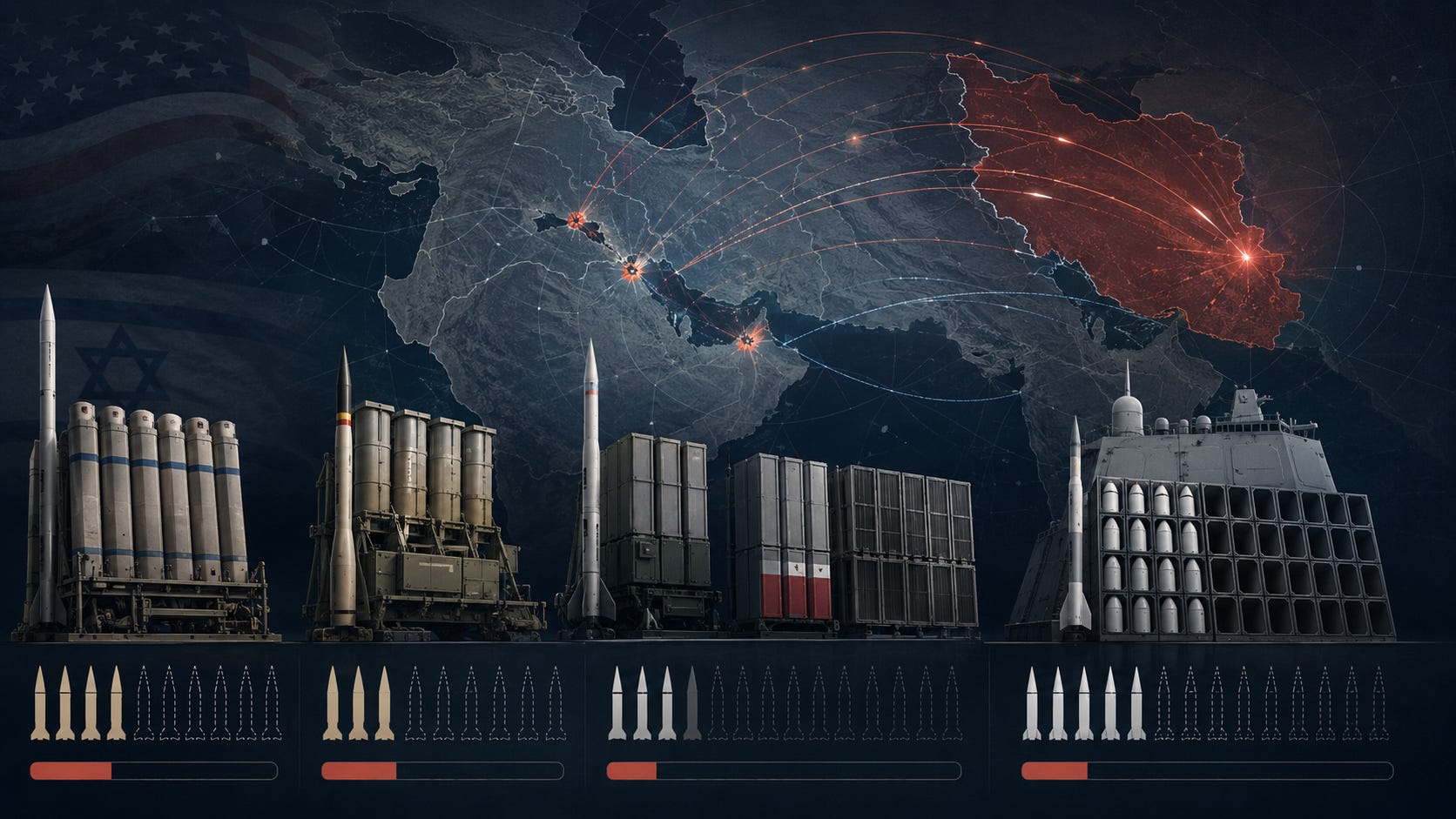
According to estimates by the Foreign Policy Research Institute (FPRI), citing the Payne Institute, Israel’s Arrow interceptor inventory (Arrow 2 / Arrow 3) was reduced by 53 percent in the first four days of the war. Replenishing the interceptors expended at the current production rate would take approximately 32 months. Importantly, replacing only the interceptors used in the first four days would take 32 months.
The same report shows that Terminal High Altitude Area Defense (THAAD) interceptors held by U.S. Arab partners were also depleted by 32.5 percent in the first 96 hours. In total, 943 U.S. Patriot interceptors were fired within 96 hours, a figure equivalent to 18 months of production on the joint Lockheed Martin/Boeing production line, which has a capacity of 620 interceptors per year.
Regarding the United States itself, the report estimates that 16 percent of U.S. THAAD interceptors and 13 percent of Patriot air-defense missiles (Patriot PAC-2 / PAC-3) were expended in only the first four days of the war.
If these percentages are compared with the Center for Strategic and International Studies (CSIS) estimate of an inventory of roughly 534 THAAD interceptors and 2,000 Patriot interceptors, U.S. expenditure in the first four days alone was equivalent to more than 10 months of THAAD production at a rate of 96 interceptors per year and about five months of Patriot production at a rate of 620 interceptors per year.
The CSIS report also states that new deliveries of THAAD interceptors to the United States have been halted since August 2023 and are scheduled to resume in April 2027, roughly one year later. The 10-month figure is therefore only the theoretical production timeline. In practice, delivery to the U.S. military would take much longer.
According to a report by the Royal United Services Institute (RUSI), total munitions expenditure by the coalition of the United States, Israel, and their allies reached 11,294 munitions in the first 16 days of the war. Replenishing the munitions used in those 16 days would probably cost more than $50 billion, and for some categories, replacement timelines are measured in years. Specifically, replacing more than 500 Tomahawk cruise missiles fired over those 16 days would require at least five years.
The RUSI report, published on March 24, 2026, states that, at this rate, the U.S. military was roughly one month or less away from severe depletion of its THAAD interceptors, while Israel would likely have approached the threshold of exhausting its Arrow interceptors by the end of March 2026.
The Center for Strategic and International Studies reported that, during the 12-day war of June 2025, the United States fired approximately 150 THAAD interceptors, equivalent to about 28 percent of the U.S. military inventory, and around 80 Standard Missile-3 (SM-3) interceptors, equivalent to about 17.4 percent of that inventory, in defense of Israel. Replacing the 80 SM-3 missiles expended in the 12-day war would require more than 14 months.
Semafor reported on March 15, 2026, citing U.S. officials, that Israel had informed Washington it was facing a critical shortage of ballistic-missile interceptors, although Israeli officials denied the claim.
Drop Site News also reported on April 9, 2026, citing a source in the Trump administration, that the number of ballistic-missile interceptors remaining in Israel’s arsenal had fallen into the “double digits” on the eve of the ceasefire.
The same report also claims that the United States expended 431 Aegis-system interceptors out of its total inventory of roughly 2,500 in defense of Israel—about 17.2 percent.
Thanks for reading! Subscribe for free to receive new posts and support my work.