 نسخه فارسی
An Agreement Out of Reach: Trump’s Tactical Pause Before the China Test
Date of the original publication: 11 May 2026
In the current circumstances, it is difficult to be optimistic about an agreement between Iran and the United States. The main obstacle is not simply disagreement over one or two issues. Rather, a series of obstacles has accumulated on top of one another.
The first obstacle is the wide gap between the demands of Tehran and Washington. Some of Iran’s demands are vital, but they cannot easily be accepted by the United States. A clear example is the Strait of Hormuz, a strategic waterway of security and economic importance to Iran. Any mechanism that consolidates Iran’s position there, however, would not be acceptable from Washington’s perspective.
The second obstacle is Israel. The United States may have room for maneuver in some areas, such as sanctions waivers or a limited reduction of pressure. But Israel opposes any agreement that would create a tangible economic gain for Iran. From Tel Aviv’s perspective, even a limited agreement could open some economic breathing room for Iran.
The issue is not only economic. Iran wants the ceasefire in Lebanon to be included in any potential agreement. For Israel, such a provision could amount to accepting a serious political and security concession. It is therefore natural that Tel Aviv would try to prevent an agreement between Tehran and Washington from taking shape.
In this same context, there is no sign of declining Israeli influence over Trump. Although criticism of Israel has increased in American public opinion, this shift has not yet entered policymaking in a decisive way. The composition of the negotiating team reinforces this impression: Steve Witkoff and Jared Kushner are two Jewish figures who are very close to Israel, and Nick Stewart has now been added to the team—a figure who emerged from the lobbying arm of the Foundation for Defense of Democracies, a hardline institution close to Israel’s security agenda on Iran.
The third obstacle is Trump’s negotiating style. Trump generally has little interest in complex, multilayered agreements based on technical details. He wants an agreement that is short, simple, and politically marketable—one that can be explained in a few sentences and sold as a “victory.”
But the Iran issue does not lend itself to that. If a genuine agreement is to be reached on the nuclear program, weapons verification, sanctions, the Strait of Hormuz, guarantees against attack, damages, and the war in Lebanon, it cannot be resolved through a brief symbolic text. Each of these issues requires lengthy technical, legal, and security negotiations. The problem is that Trump does not appear to want such a process. He seems more interested in obtaining a clear “yes” from Iran to Washington’s list of demands than in entering into a genuine and complex give-and-take.
The composition of the U.S. negotiating team further complicates matters. Witkoff and Kushner come from the world of dealmaking and real estate more than from professional diplomacy. Such a background may be an advantage within Trump’s mindset, but negotiating with Iran, especially in the context of a regional crisis, requires a deep understanding of diplomacy, security, international law, and geopolitical balances.
From this perspective, Iranian negotiators in the nuclear talks have faced a recurring problem: the American side either does not properly grasp the technical and political complexities of the issue or cannot convey them accurately and reliably back to Washington. Similar dissatisfaction has also been expressed by Russian officials in negotiations over the war in Ukraine.
The substance of these complaints is the same: negotiators close to Trump approach issues of a security, historical, and geopolitical nature through transactional logic, rather than as representatives of a coherent diplomatic process. This is not an individual failing; it is part of Trump’s broader view of negotiation. He sees negotiation not as a process for building a balanced agreement, but as a tool for securing a “yes” to U.S. demands. Within such a framework, it is natural that the complexity of the crisis would be overlooked.
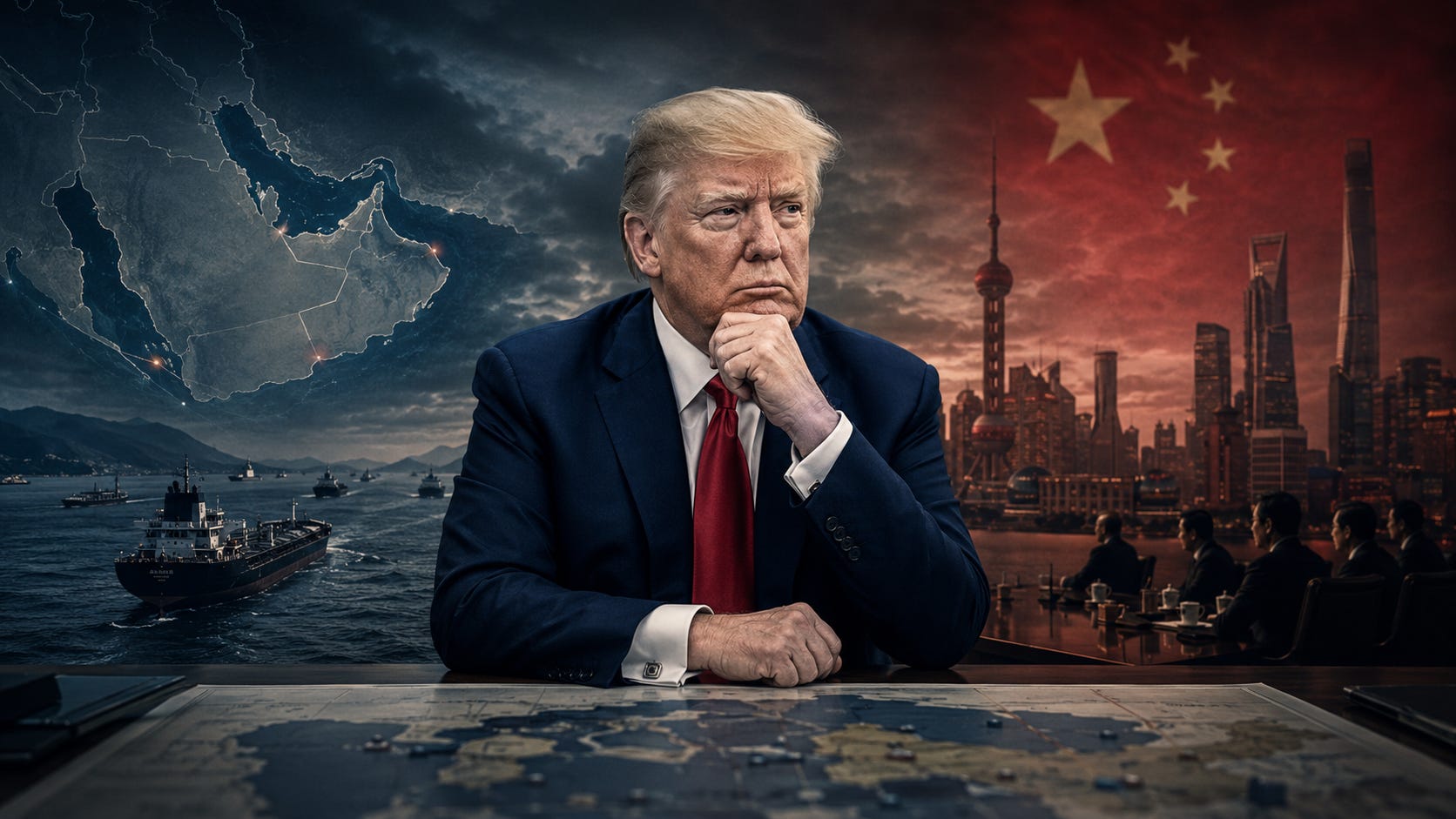
Therefore, in the short term, at least until Trump’s meeting with Xi Jinping, the most likely scenario is the continuation of the state of “neither war nor peace”: a situation marked by pressure, threats, a maritime blockade, and limited clashes below the threshold of full-scale war.
But this situation is not necessarily stable. Trump’s meeting with the Chinese president could be an important test for the next phase. If Trump believes he can exert effective pressure on Iran through Beijing, he will probably continue along this path of indirect pressure. But if he concludes that China is unwilling or unable to serve as a lever of pressure against Tehran, the possibility of escalation becomes more serious.
From this perspective, the current situation is more of a “tactical pause” than a stable equilibrium.
Thanks for reading! Subscribe for free to receive new posts and support my work.